
Leak Detection & Repair in Kirklees and Calderdale
A damp patch that keeps coming back, a boiler you top up every week, a meter that never stops turning. We trace the leak back to where it starts, on the heating, the mains or the waste, and repair it. Gas Safe registered and based at Hartshead.
Smell gas? Call 0800 111 999 before anything else.
That is the National Gas Emergency line, free and open around the clock. Do not use light switches or anything that could spark, open the doors and windows, turn the gas off at the meter if it is safe to reach, and get everyone outside before you ring. They make the property safe. Finding and repairing the leak afterwards is a job for a Gas Safe registered engineer, and that is the part we do.
Leaks We Find and Fix
Heating, Mains or Waste? Two Checks Before You Call
A house has three separate places a leak can come from, and they behave differently. The central heating is a sealed loop of water running through the boiler and radiators. The mains supply feeds the taps, toilet and combi hot water. The waste pipes carry water away, and only leak when something is draining.
You can narrow it down yourself. Look at the pressure gauge on the front of the boiler: if it keeps falling and needs topping up, the heating loop is losing water. Then turn off every tap and appliance and watch the water meter for a few minutes: if it is still moving, the leak is on the mains side. If neither shows anything and the damp only appears after a bath or shower, a waste or a seal is the likely cause.
Tell us what you saw when you ring. It does not replace the visit, but it means the search starts in the right place.
How We Trace a Leak
Water runs along pipes, joists and the tops of ceilings before it finds a way through, so the stain in one room often belongs to a joint somewhere else. The work goes from the cheapest answer to the most disruptive, in this order:
A Boiler That Keeps Losing Pressure Has a Leak
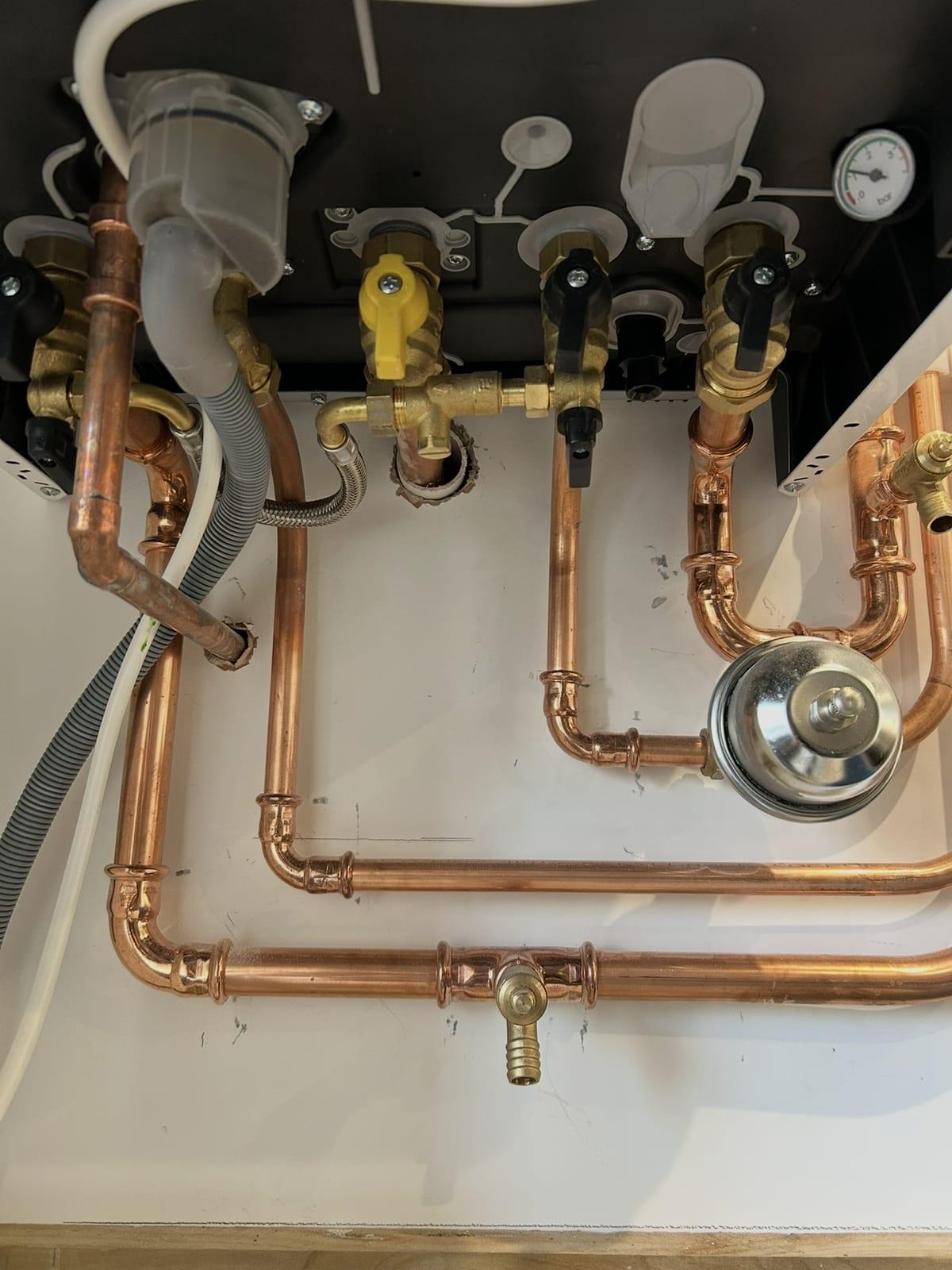
A sealed heating system should hold its pressure for months. If you are re-filling it every week or two, water is leaving it: a weeping radiator valve, a joint under the floor, the boiler itself, or the pressure relief valve letting water out through the small pipe that runs to the outside wall.
Topping up keeps the heating on, but every refill brings in fresh water, and fresh water brings oxygen. In West Yorkshire's soft water that means more corrosion and more of the black sludge that settles in radiators and the boiler. Finding the leak stops that cycle. If the system has been topped up for a long time and is already sludged, a power flush may be worth discussing too; we will tell you plainly if it is not.
If the water is coming from inside the boiler casing, the fix is a boiler repair, which needs a Gas Safe registered engineer because it means opening the appliance.
Gas Leaks: The Emergency Line First, Then the Repair
A smell of gas, or a hiss near a gas pipe or appliance, is not something to diagnose yourself or to wait for an engineer on. Ring the National Gas Emergency line on 0800 111 999 from outside. They attend, check for an escape and make the property safe, which can mean turning off or capping the supply.
The emergency service does not normally repair the leak. Once they have made it safe, a Gas Safe registered engineer has to find where the gas is escaping, repair it, and test the whole installation for tightness before the supply is turned back on and the appliances used again. We do that work, under Gas Safe registration 962740.
Carbon monoxide is a different danger: it has no smell. Headaches, dizziness or nausea that ease when you leave the house, or a CO alarm sounding, should be treated as an emergency in the same way, with the same number.
What to Do While You Wait
- Water on the mains side: turn it off at the stopcock, usually under the kitchen sink or where the supply comes in. If it is stiff, leave it rather than forcing it.
- Water near electrics: switch off at the consumer unit before going near it.
- Water from the boiler or heating pipes: switch the boiler off.
- Photos: of the damp, the meter and the boiler gauge. They help the diagnosis, and many home insurance policies include trace and access cover for finding a hidden leak, so check yours before work starts.
Want the longer version? Our guide Water or gas leak? How to spot one and what to do first covers the signs in more detail.
Leak Detection Near Our Hartshead Base
We work across Kirklees and Calderdale, and most often in the towns and villages closest to base: leak detection in Brighouse, leak detection in Mirfield, leak detection in Heckmondwike, leak detection in Liversedge, leak detection in Cleckheaton, leak detection in Roberttown and leak detection in Hartshead. Further afield, including Sowerby Bridge, Dewsbury and Huddersfield, ring and ask.
Why Choose Pickles Gas
Got a Leak You Can't Pin Down?
Gas Safe Registered · No Hidden Call-Out Fee · One Price Before Any Work
Areas We Cover
What Customers Say About Our Leak Repairs
Rated 5.0 from 34 Google reviews. Read them all
Needed a gas engineer to locate and repair a leak in the house. Haydn did a great job. Rang me when he said he would, turned up and got straight to work. For such a young man he’s is very knowledgeable in his field. Quality work at a fair price.
Debbie Jones
Gas Leak Repair · Google
Had a leak in one of my pipes in the boiler. Pickle's gas engineers were able to come out and resolve the issues. Thanks very much.
Abu Khan
Boiler Repair · Google
Called Pickles as I had a boiler leak and he came within 24 hours and got it all sorted. Was very professional, clean and friendly. 5 star service, definitely recommend!!
Anna Beaumont
Emergency Callout · Google
Frequently Asked Questions
Not first. Call the National Gas Emergency line on 0800 111 999 from outside the property: it is free and open around the clock. Do not use switches or anything that could spark, open the windows, and turn the gas off at the meter if it is safe to reach. The emergency service makes the property safe. After that, a Gas Safe registered engineer has to find the leak, repair it and test the installation before the gas goes back on, and that is the part we do.
Look at two things. The pressure gauge on the boiler: if it keeps falling and needs topping up, water is leaving the sealed heating circuit. And the water meter: if it is still turning with every tap and appliance off, the leak is on the mains side. Tell us what you see on both when you call; it narrows the search before we arrive.
There is no hidden call-out fee. We find the leak and explain the cause first, then give you one price for the repair before any work starts.
Many policies include trace and access cover, which pays towards finding a hidden leak and getting to it. Check your policy before work starts, and take photos of the damage, the water meter and the boiler gauge. Insurers usually ask for the cause, which we explain once the leak is found.